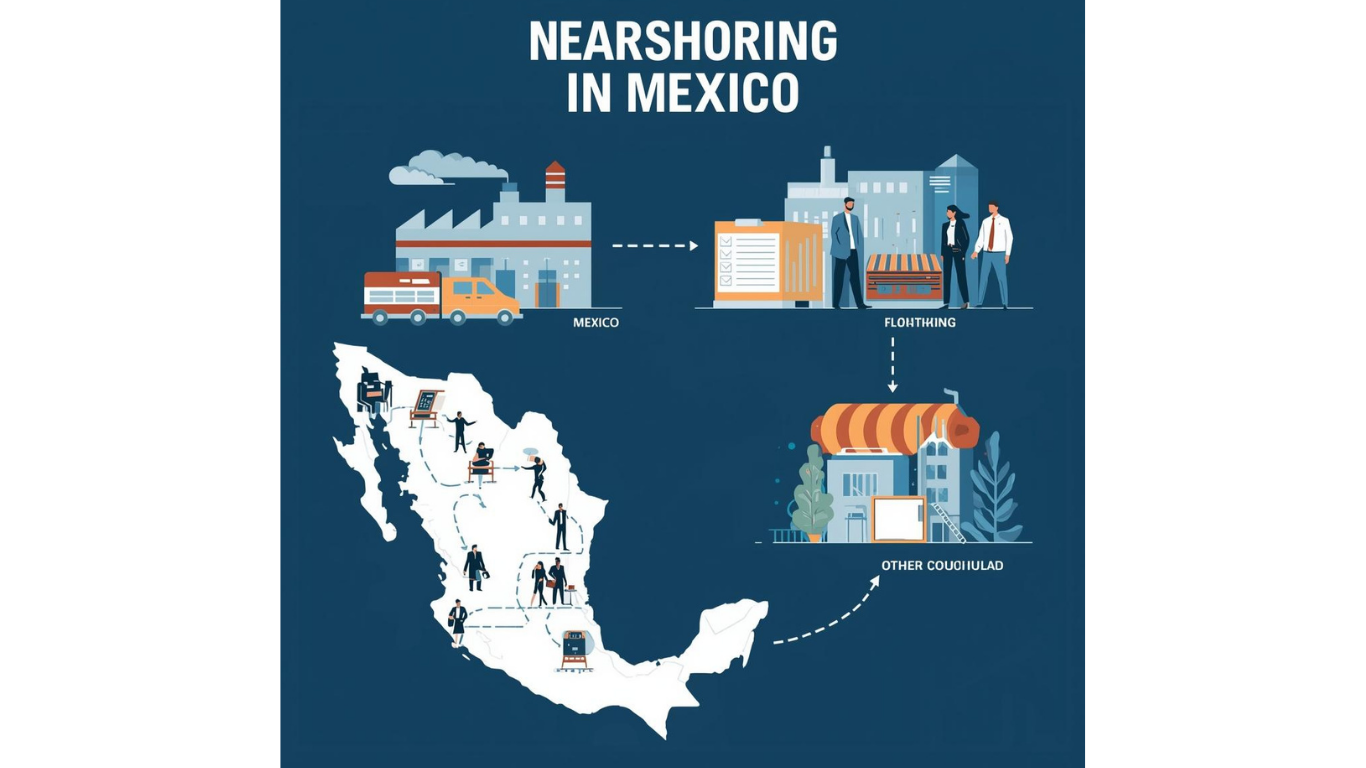
As nearshoring gains attention globally, U.S. companies are increasingly evaluating nearby countries as alternatives to traditional offshore locations.
Among these options, Mexico is frequently mentioned — not as a universal solution, but as a practical candidate in many cases.
Nearshoring: A Brief Overview
Nearshoring is a business strategy in which a company relocates certain operations or functions to a nearby country to address rising domestic costs while maintaining closer geographic and operational alignment.
Why Mexico Is Often Considered by U.S. Companies
Mexico offers several practical advantages for U.S. companies considering nearshoring.
Key factors commonly cited include:
- Geographic proximity to the United States
- The USMCA trade framework
- Labor cost advantages
- Established manufacturing infrastructure
Recent Nearshoring Trends in Mexico
Recent Nearshoring Trends in Mexico
In recent years, the number of U.S. companies considering or implementing nearshoring in Mexico has increased, particularly in areas such as manufacturing, shared services (SSC), and back-office or support functions.
Advantages and Limitations of Nearshoring in Mexico
Advantages
- Minimal time zone differences
- Relatively competitive labor costs
- Improved operational coordination
Limitations
- Cost assumptions
- Compliance complexity
- Organizational readiness
- Handling work that involves sensitive or confidential information
*However, these advantages do not apply uniformly to all companies.
Why Company Context Matters
Before implementing nearshoring in Mexico, several company-specific factors should be carefully considered.
- The suitability of nearshoring often depends on the industry and the types of functions a company intends to relocate.
- Company size is also an important factor when evaluating whether nearshoring is an appropriate strategic option.
- In addition, the decision-making structure for shared services or centralized functions should be clearly defined.
- Finally, a company’s internal maturity — including process standardization and management capability — can significantly affect the success of a nearshoring initiative.
These challenges become even more pronounced when companies attempt to implement shared services or SSC models without sufficient preparation.
A more detailed analysis of common SSC pitfalls in Mexico is available here:
→ Why SSC Plans Often Fail in Mexico
From Overview to Feasibility Assessment
While Mexico is often considered a viable nearshoring option, the actual feasibility depends on how operations, governance, and responsibilities are designed.
For companies evaluating nearshoring through shared services or centralized functions, a structured feasibility validation is often a practical next step.

Leave a Reply